The Importance of Dental Implants
Dental implants are changing the way people live. Patients with dental implants are rediscovering the comfort and confidence to eat, speak, laugh and enjoy life. Implants are designed to provide a foundation for replacement teeth that look, feel, and function like natural teeth. If you are missing one or more teeth, implant dentistry is an option that you should consider. Contact us today at 610-524-0115 to schedule your consultation with our dentist, Dr. Andrew Hoffman, and find out if you are a candidate for dental implants in Exton, Pennsylvania.
This method of teeth replacement has been supported by decades of research and is highly preferred by dentists. The person who has lost teeth regains the ability to eat virtually anything and can smile with confidence knowing that his or her new teeth appear natural. In addition, dental implants can help preserve facial contours and structure along with preventing jawbone deterioration that occurs when teeth are missing.
Dental implants are small titanium posts that are surgically inserted into the jawbone where teeth are missing. The titanium posts are metal anchors that act as tooth root substitutes. The bone bonds with the titanium, creating a strong foundation for artificial teeth. Small posts called abutments are then attached to the implant to provide stable anchors for artificial replacement teeth.
Advantages of Dental Implants
- Preserve facial contours and prevent jawbone destruction
- Easier eating — implants function similar to natural teeth.
- Improved oral health
- Improved appearance
- Improved speech — proper enunciation of certain words is a common problem with ill-fitting dentures; this is not a problem with dental implants
- Improved comfort
- Improved self-esteem — implants will give you the confidence to smile and feel better about yourself
- Variety of options for missing teeth (single-tooth implant, implant-supported bridgework, implant-supported dentures)
- Durability and longevity — implants have a 97% success rate; this makes them the most economical long–term solution available, and through regular dental visits and good oral hygiene, implants can last a lifetime
Risk Factors That Greatly Affect the Success Rate of Dental Implants Include:
- Heavy Smoking or Other Tobacco Use
- History of radiation therapy to the head or neck region
- Uncontrolled diabetes
- Osteoporosis
- Heart Disease
Evaluation for Dental Implants
If you are considering dental implants, our office can perform visual and radiographic examinations to help determine if there is adequate spacing and bone density in order to qualify you as a candidate for implant dentistry.
Dr. Hoffman will then refer you to either a periodontist or an oral and maxillofacial surgeon where, after consultation, a final decision will be made in regard to your qualifying as a candidate for dental implants. The periodontist or the oral and maxillofacial surgeon will place and uncover the implants, and our dentist will restore the implants. Rest assured that Dr. Hoffman will work closely with either of these specialists to help make your procedure a success.
In general, you need to have healthy gums and adequate bone to support the implants. Also, you must be committed to good oral hygiene and regular dental visits.
Dental Implant Procedure
For most patients, the placement of dental implants involves two surgical procedures. Initially, the specialist, using local anesthetic, places the implants within your jawbone. For the first two to six months following surgery, the implants are beneath the surface of the gums, where they will gradually bond with the jawbone. During this time, you will normally wear a temporary prosthesis.
After the implant has bonded to the jawbone, the second phase begins. The specialist will uncover the implants and attach a small healing collar. Dr. Hoffman can then start making your new replacement teeth. Small posts (abutment attachments) will be connected to the implants. An impression is then taken, and the replacement teeth are made to custom fit over the posts or attachments. The entire process usually takes six to eight months, and during this time, patients experience minimal disruption in their daily life.
Dental Implant Technology and Advances
Due to the most recent advances in dental implant technology, there are occasional instances in which the specialist is able to place single-stage implants. They are placed at the same time as a tooth is extracted. These implants require only one surgical procedure (one visit) and a minimum healing time of two to three months before the replacement (artificial) teeth are placed.
Dental Implant Options for Tooth Replacement
VARIOUS PROSTHETIC OPTIONS FOR REPLACING MISSING TEETH THAT ARE ANCHORED BY IMPLANTS INCLUDE:
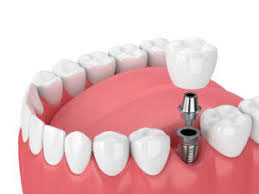
- Implant-Supported Crown –– This is utilized to replace one missing tooth. A crown is permanently placed over a single implant. This treatment option has the highest success rate for replacing a single missing tooth.
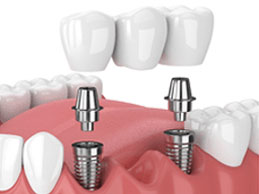
- Implant-Supported Bridge –– This is fabricated to replace two or more teeth. An implant is not required for every missing tooth. For example, implants can be placed on both sides of a gap to act as supports for a fixed bridge. This treatment method is advantageous because natural teeth are not needed to support the fixed bridgework. Multiple implants can be used to support a fixed bridge that replaces all the teeth in the upper or lower jaw. This fixed bridge is permanent and can only be removed by the dentist.
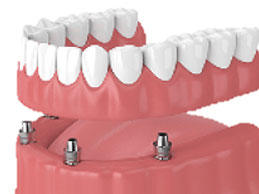
- Implant-Supported Overdenture –– Implants are placed in order to provide comfort and stability for a complete denture. In the lower jaw, a removable denture attaches to two implants. This effectively prevents the tongue from dislodging a lower denture when eating and speaking. In the upper jaw, a removable denture attaches to more than two implants because there is less bone density than in the lower jaw. Implants also make upper and lower dentures more comfortable to wear.
Care and Maintenance
Daily brushing and flossing, along with regular dental cleanings and exams, are vital in order to prevent peri-implantitis (a destructive bacterial infection caused by poor oral hygiene and insufficient professional dental cleanings). Excessive biting forces (which can be destructive to your implant) can be caused by a habit of teeth clenching or grinding. Dr. Hoffman will recommend that you receive a night guard to alleviate teeth clenching and grinding. Maintaining diligent care will ensure that your implants have the potential to last a lifetime.
LINK:
Want to learn more about after care? Go here.